

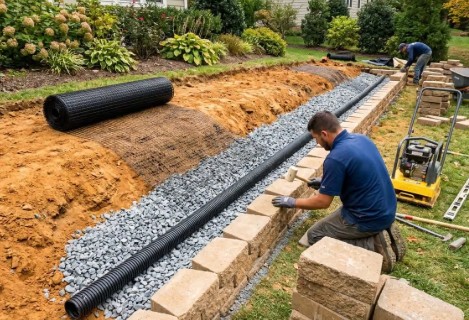
A retaining wall can hold back many tonnes of soil, and on most properties it does that job quietly for years. When something starts to go wrong, the signs tend to appear slowly: a slight tilt at the top, a few blocks that no longer line up, or a damp patch on the face after heavy rain. Across Toronto and York Region, where heavy clay soils meet repeated freeze-thaw cycles, those early signs are worth taking seriously.
The good news is that not every leaning wall needs to be torn out. The key is understanding why it is moving and whether the problem is limited to one section or affects the whole structure.
Why Retaining Walls Start to Lean
Water is behind most failures. When rain and snowmelt soak into the soil behind a wall and cannot drain away, the pressure on the back of the wall rises sharply. Properly built walls deal with this using a zone of clear crushed stone directly behind the wall and a perforated drain pipe at the base that carries water out. Many older walls were built with neither.
Clay soil adds another problem. It holds water, swells when wet and expands when it freezes, pushing against the wall every winter. Over several seasons, that repeated push can tip a wall forward a little at a time. Other common causes include a base that was too thin or poorly compacted, a first course of blocks that was not buried deep enough below grade, taller walls built without geogrid reinforcement, and extra weight near the top of the wall from a driveway, shed, pool or piles of snow. Timber walls have their own limit: wood eventually rots, and once the posts and ties soften, the wall loses its strength.
Signs That a Wall Is Moving
Some warning signs are easy to spot from the lawn. The top of the wall leans out further than the bottom. The face bulges in the middle. Blocks have shifted, cracked or separated, leaving gaps that let soil wash through. Water seeps from the face or pools along the top after rain. A fence at the top of the wall begins to lean, or the patio behind it starts to settle.
A simple way to tell whether a wall is still moving is to hold a long level against the face at several points, note the readings and take photos from the same spots. Repeating the check in spring shows whether the lean has increased over the winter. A wall that changes noticeably over one season is actively moving and should be looked at soon.
When Repair Makes Sense
Repairs are often possible when the problem is local. A few cap stones that have come loose, a short run of blocks displaced near the top, or a section of armour stone that has settled at one end can usually be lifted, the base corrected and the units reset. If the root cause is surface water, regrading the soil at the top of the wall and redirecting downspouts that empty behind it can stop further movement.
An experienced team that handles retaining wall repair in Toronto will typically open up a section of the wall to see what is behind it before recommending a fix. What they find there, such as whether drainage stone and a drain pipe exist and whether the base is intact, usually decides whether a repair will last.
When Rebuilding Is the Better Investment
Rebuilding becomes the sensible choice when the lean runs along most of the wall, when the face is bulging, when a timber wall has rotted, or when the wall was built with no drainage at all. Pushing a leaning wall back into place does not address the cause, and it will tip again. A proper rebuild means excavating behind the wall, installing a compacted granular base, adding clear stone backfill and a drain pipe, and including geogrid layers where the height requires them. Natural armour stone can often be reused, which keeps part of the original character and reduces the cost of new material.
Height and location matter too. Taller walls, walls close to a property line and walls on ravine lots can trigger permit and engineering requirements, and some sites are regulated by the local conservation authority. These questions should be settled before any work begins.
What to Do Before Spring
Frozen ground makes excavation difficult, so most major wall work in the GTA happens between spring and late fall. In the meantime, homeowners can reduce the strain on a struggling wall: keep vehicles and heavy items away from the top, avoid piling shovelled or plowed snow behind it, and make sure downspouts discharge well away from the wall. Booking an assessment over the winter puts a property near the front of the queue when the building season opens, and leaves time to plan a repair or rebuild that will stand for decades.
