

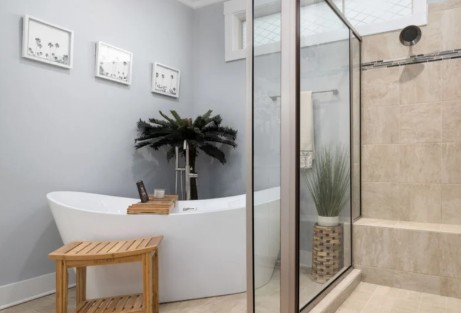
A glass shower door is one of the last things installed in a bathroom renovation, yet it is one of the first things anyone notices. It frames the tile work, decides how open the room feels, and gets touched every single day. Because it is made to measure and cannot be altered once the glass has been tempered, it pays to understand the choices before the order is placed.
Across Toronto and the GTA, the same handful of questions come up on almost every project: how much frame to use, how thick the glass should be, which hardware will last, and how to keep the glass clear in a region with mineral-rich water.
Frameless, Semi-Frameless or Framed
Frameless doors use heavy tempered glass, typically 3/8 inch (10 mm) or 1/2 inch (12 mm) thick, held by hinges and clips with no metal surround. They suit modern bathrooms and make a small room feel larger, because the eye passes straight through to the tile behind. Semi-frameless designs use thinner glass with a partial frame, often around the fixed panels, which keeps costs down while still looking clean. Fully framed doors use the thinnest glass and rely on the metal surround for strength. They are the most budget-friendly option and remain practical in rental units and secondary bathrooms.
Heavier glass is not only about appearance. A thick frameless panel feels solid when it opens and closes, and it is less likely to flex over years of daily use. The trade-off is weight, which places more demand on the hinges and on the wall framing behind them.
Match the Layout to the Room
The shape of the shower usually decides the configuration. An inline layout, with a door and one or more fixed panels set between two walls, is the most common choice for alcove showers and tub-to-shower conversions. Corner enclosures use two glass walls meeting at a right angle, while neo-angle designs cut across a corner with an angled front to save floor space. Walk-in showers may need only a single fixed panel with no door at all, and sliding doors work well where there is no room for a door to swing.
Steam showers are a special case. They need glass that runs close to the ceiling, tight seals all the way around and often a transom panel above the door, so the enclosure can hold vapour without letting moisture escape into the rest of the house.
Why Measuring Happens After the Tile
Tempered glass cannot be cut or drilled after it is manufactured; any attempt makes it shatter. That is why reputable installers take final measurements only once the walls, curb and floor are tiled. Walls in older Toronto homes, and even in new builds, are rarely perfectly plumb, and a few millimetres of variation over the height of a shower makes a visible difference to the gaps around a frameless door. Measuring the finished surfaces lets the glass be cut to suit the room exactly.
Homeowners comparing glass shower doors in Toronto should ask how each company handles this site measurement, what the lead time is for custom glass, and whether the quote includes hardware, seals and installation. Clear answers up front avoid surprises on installation day.
Hardware That Lasts
Hinges and handles take more wear than any other part of the enclosure. Solid brass or stainless steel hardware with a quality finish holds up far better than lightweight alloys. Wall-mounted hinges are typical for frameless doors, while pivot hinges set at the top and bottom of the door allow wider openings. Popular finishes include polished chrome, brushed nickel, matte black and brushed gold, and it is worth matching them to the faucet and shower trim so the room reads as one design. Most installers also recommend a door that swings out of the shower rather than in, both for everyday comfort and so it can always be opened from the outside in an emergency.
Dealing With Hard Water
Much of the GTA has moderately hard water, and some communities that draw on groundwater see even higher mineral levels. Every time water dries on the glass, it leaves a thin film of calcium and magnesium that builds up into cloudy spots. A protective coating makes the glass surface more water-repellent, so droplets bead and run off instead of drying in place. Many suppliers apply these coatings at the factory, and they are far easier to put on before installation than after.
Daily habits make the biggest difference. A quick pass with a squeegee after each shower, followed by a mild, non-abrasive cleaner once a week, keeps most glass clear for years. Abrasive pads and harsh chemicals can damage both the coating and the hardware finish.
Low-Iron Glass and Water Control
Standard clear glass has a slight green tint that shows along the edges and becomes more noticeable as the glass gets thicker. Low-iron glass removes most of that tint, so white and marble tile looks true to colour through it. It costs more, but many homeowners consider it worthwhile on a large frameless enclosure.
Frameless doors also leave small gaps between the glass and the walls so the door can swing freely. Clear vinyl seals and bottom sweeps close those gaps, and positioning the shower head so it does not spray directly at the door helps keep water where it belongs. A properly sloped curb, or a well-planned curbless floor with a linear drain, completes the picture. With the right glass, hardware and care routine, a shower door should look as good years from now as it does on the day it is installed.
