

Many small and mid-sized food producers reach a point where hand-filling cups stops making sense. Orders from regional grocers grow, a co-packing contract comes in, or labour becomes harder to schedule, and the team that once portioned hummus, salsa or yogurt with scoops and scales can no longer keep up. At that stage, the conversation usually turns to automation, and one of the first questions is which machine format suits the plant.
For producers of dips, spreads and dairy cups, two broad layouts dominate: inline machines, where cups travel in straight lanes through a series of stations, and rotary machines, where cups ride around a circular turret. Both can produce a clean, sealed retail cup. The right choice depends on floor space, output targets, product range and how often the line changes over.
How a Turret-Based Filler Works
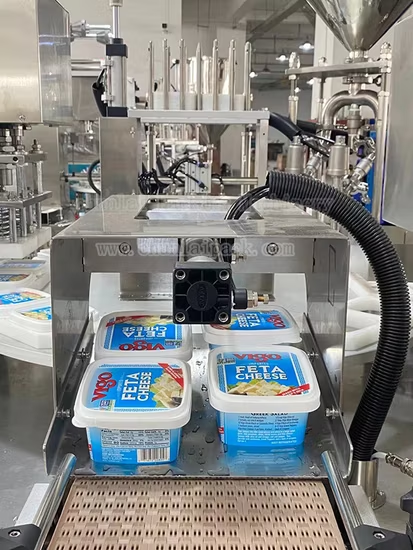
A rotary cup filling machine carries pre-formed cups around an indexing dial plate. The turret moves one position and pauses, and while it is stopped each station performs its task at the same time: one drops an empty cup from a stack, another deposits product, another places and seals a film or foil, and a final station may press on a snap lid before the finished cup is pushed out. Because the stations sit in a circle rather than a long line, the entire process fits on a compact frame.
That pause, often called dwell time, matters more than many first-time buyers expect. Thick products such as hummus, nut butter and cream cheese need a moment to leave the nozzle cleanly, and heat sealing needs consistent contact time to bond film to the cup rim. Intermittent motion gives each step a controlled window, which helps with fill accuracy and seal integrity on viscous foods.
Where Rotary Layouts Make Sense
Rotary machines tend to suit operations that want a full fill, seal and lid sequence without dedicating a long stretch of production floor to it. Smaller plants, shared commercial kitchens that have grown into dedicated facilities, and producers adding a second product line often fall into this group.
They also suit businesses that run many SKUs in moderate volumes. A dip company may run classic hummus in the morning, a roasted red pepper variety after lunch, and a tzatziki or salsa before the end of the shift. On a compact turret machine, switching cup sizes typically means changing a set of dial plate tooling and adjusting the fill volume, rather than reconfiguring several parallel lanes.
Inline machines, by contrast, are often chosen when a plant runs very high volumes of a small number of products. Multiple lanes can multiply output, but the trade-off is a longer footprint and, usually, more involved changeovers. Neither format is better in every case; they are designed for different production profiles.
Questions to Ask Before Buying
A few practical questions are worth working through before requesting quotes.
What is the realistic output target? Manufacturer speed ratings are usually measured under ideal conditions. Real-world output depends on product viscosity, cup size, operator experience and how often the line stops for hopper refills or film changes.
Which products will run on the machine? Smooth purees, chunky salsas and products with visible pieces all behave differently in a filler. Piston fillers with suitable valves handle a wide range of viscosities, but particulates can affect nozzle selection. Bringing product samples to a trial run is one of the most useful steps a buyer can take.
How will the cups be sealed and lidded? Heat-sealed film offers tamper evidence and a cleaner shelf presentation, while a snap-on lid lets consumers reclose the cup. Many fresh dip products use both. Some producers also look at nitrogen flushing to displace oxygen in the headspace, which can support shelf life for oxygen-sensitive products when it is paired with proper cold-chain handling.
What does cleaning look like? Food-contact parts should be food-grade stainless steel, and the hopper, piston and nozzles should come apart without special tools. Daily sanitation time is a hidden cost that adds up quickly over a year.
Planning the Transition
Automating cup filling changes more than the packing table. Upstream, batch sizes and holding temperatures may need to adjust to keep a steady supply of product in the hopper. Downstream, date coding, checkweighing, case packing and cold storage all need to keep pace. Food safety plans should be reviewed to reflect the new equipment, including allergen changeover procedures if the machine will run products containing sesame, dairy or tree nuts.
It also helps to involve the people who will run the machine early. Operators who understand how the turret indexes, how to adjust fill weights and how to swap tooling tend to get better uptime from the first week.
The Bottom Line
For many growing dip, spread and dairy producers, a compact turret-based filler offers a practical path from manual portioning to consistent, sealed retail cups. The key is matching the machine to real production needs rather than headline speed figures, testing it with actual products, and planning the surrounding workflow so the new equipment can deliver steady, repeatable results.
