

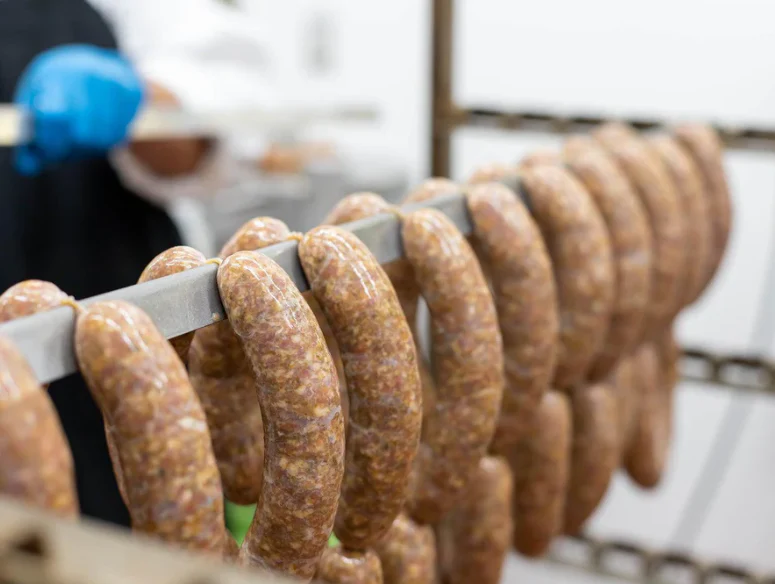
Ask any sausage maker about their recipe and they’ll talk for an hour about the meat, the fat ratio, the spice blend, the smoke. Ask them about their casing and you’ll often get a shrug. That always surprises me, because the casing is the one component touching every single link they make — and when it’s wrong, nobody is tasting the carefully balanced seasoning. They’re looking at a split, wrinkled, or rubbery sausage and quietly deciding not to buy it again.
A casing isn’t just a wrapper. It decides how the sausage holds its shape, how it takes smoke, whether there’s a snap when you bite in, and how well it survives cooking and handling. Get it right and it disappears into the experience. Get it wrong and it’s the only thing anyone notices.
Part of the reason casings get ignored is that there are more options than people realize, and the differences are real. Natural casings give that traditional snap and irregular charm, but they vary from batch to batch. Collagen casings are consistent and easy to run on a stuffer, which is why high-volume producers lean on them. Fibrous casings are tough, hold their shape, and take printing beautifully — ideal for large summer sausages and deli meats. Cellulose casings are peeled off before sale, perfect for skinless franks. Plastic and high-barrier casings lock in moisture and stretch shelf life for cooked products. Each one is a different tool, and matching the tool to the job is most of the battle.
The mistake I see again and again is people choosing a casing out of habit and then fighting it forever — blaming their stuffer, their recipe, or their luck when the real issue is the wrong casing for the product. A casing meant for a dry-cured salami behaves nothing like one built for a cooked, smoked sausage. Calibre matters too: a few millimetres changes cook time, portioning, and how the finished link looks on the tray.
If you’re buying sausage casings in Canada, my honest advice is to treat your supplier as a resource, not just a vendor. The good ones carry the full range — natural, collagen, fibrous, cellulose, plastic — and will tell you which calibre and material actually suit your product instead of selling you whatever moves fastest. They’ll walk you through printing options if you want your brand on the casing, and they’ll have technical support for the day a run misbehaves. That kind of help is worth far more than shaving a few cents off a box.
Consistency is the other thing worth paying for. When your casings arrive identical every time, your process gets predictable — same soak, same stuffing pressure, same cook. When they don’t, you’re recalibrating constantly and tossing the rejects. For anyone making sausage at scale, a reliable casing supply is quietly one of the biggest levers on both yield and quality.
So here’s my take: spend a little more time on the part of the sausage you can’t taste. Learn the casing types, match them honestly to what you’re making, and build a relationship with a supplier who knows the difference. Your customers will never once compliment your casing — but they’ll keep coming back for sausages that look right, snap right, and never let them down. That’s the whole point.
This article represents is a guest opinion piece and doesn’t necessarily coincide with the positions of the company. For more information about our company’s stance, please get in touch with us directly.
